




577
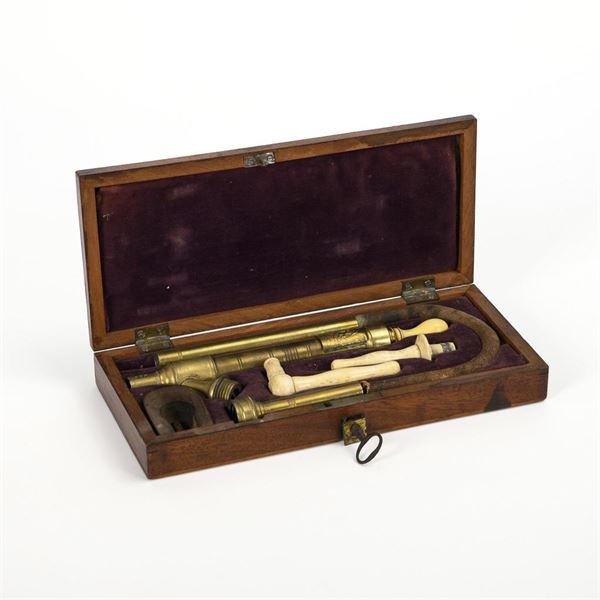
Historical Enema Syringe.
Brass, leg. The case measures 22.5 x 10.0 x 3.0 cm. 525 g.
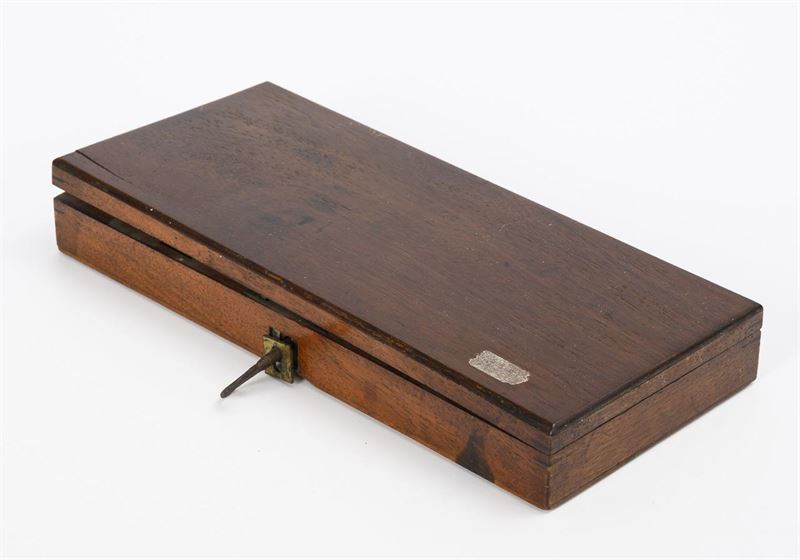
Historic enema syringe with tubing and accessories in a velvet-lined mahogany box. Attached to the main tube is a thin brass plaque embossed with the royal coat of arms and the inscription Read’s Patent, indicating that the design was patented. The tubing is broken off at one end from its brass attachment; the patent plaque is loose on one side. The box has its original lock, though the hardware is loose. The lid of the box has a crack on the left side, causing it to be slightly warped.
John Read (1760–1847) was a gardener in the service of an English country clergyman. According to the biography provided in the biography of his patron, Sir Astley Cooper, Read—who was expected to take over his father’s farm—had been interested in devices featuring technical mechanisms from a very early age and, accordingly, tinker with them on his own in his spare time. Recognizing Read’s talents, his employer granted him access to his library, through which Read acquired extensive knowledge of hydrostatics, as well as anatomy, which ultimately led—after he designed an innovative irrigation system with hoses for the clergyman’s garden—to the invention of his novel enema syringe, intended for the removal of toxic substances from the intestines. In London, he was able to win over the renowned anatomist and surgeon Sir Astley Paston Cooper (1768–1841) as a patron, who popularized Read’s invention among experts.
The call time for this item is Oct. 28, 2026, at approximately 4:48 p.m. (CET).
Limit 90 €
• LIVE Auction starts in 6 days
• Calling time: 28. | Oct 2026 | approximately 16:48 uhr
Log in
• Calling time: 28. | Oct 2026 | approximately 16:48 uhr
International shipping quote
Non-binding estimate by our partner ThePackengers. Not applicable to shipments within Germany (shipped by us via DHL). Terms: www.thepackengers.com